
Every time a new AI model rolls out, you can almost hear the internet holding its breath. “Is this the one that finally puts designers and product people out of work?” But if you’ve ever actually built a product, you know it’s not that simple. Sure, AI can whip up wireframes, suggest copy, even run some experiments. But the real magic of product thinking? That’s still stubbornly, gloriously human.
AI lacks human experience
Let’s be honest. AI is like that super-smart intern who graduated cum laude but never actually got their hands dirty. It knows about users, but has never actually been on a call where someone describes their pain point in a way that makes you want to cry (or at least slam your laptop shut and go for a walk). Experience matters. Not just the years you’ve spent in the trenches, but the local flavour you bring; whether that’s a gut instinct for what will delight users in London versus Milan, or just the memory of all the times you fell flat and had to pick yourself up. To make it easier to understand, AI might tell you the most precise recipe for a classic Carbonara. But has it ever tasted the Pancetta? No Sir.
Empathy matters.
Empathy isn’t just a LinkedIn skill; it’s a real thing. AI can analyse sentiment, sure, but it can’t feel awkward silence in a user interview, or sense when someone’s frustrated but being polite. It doesn’t notice the little sigh when a process is too clunky, or the smile when something just works. Product people feel that, and it shapes every decision.
Business empathy is a whole other beast. Ever observed a showdown between a Product Owner, developer and CFO negotiate ambition versus feasibility versus budget? That’s not just math. That’s diplomacy. AI might recommend “optimal tradeoffs,” but it doesn’t get politics, egos, or the subtle art of getting buy-in without selling your soul. The human side of product is as much about people as pixels.
What fuels real creativity.
And let’s talk creativity. AI’s got infinite remix powers, but it’s remixing what it’s seen. The true “aha!” moments, the weird ideas born from a late-night snack or a shower epiphany, don’t come from training data. They come from the beautiful mess of human experience. Like that time Post-its were invented because someone needed a bookmark that didn’t fall out; AI would’ve just suggested a stronger bookmark, not “what if we use weaker glue?”
AI can also be painfully generic. Ask it to write UX copy and you’ll get something that will feel like the HR department wrote it. Humans bring the spice, the personality, and the little quirks that make a product lovable (or at least, memorable).
Conflicts and concerns
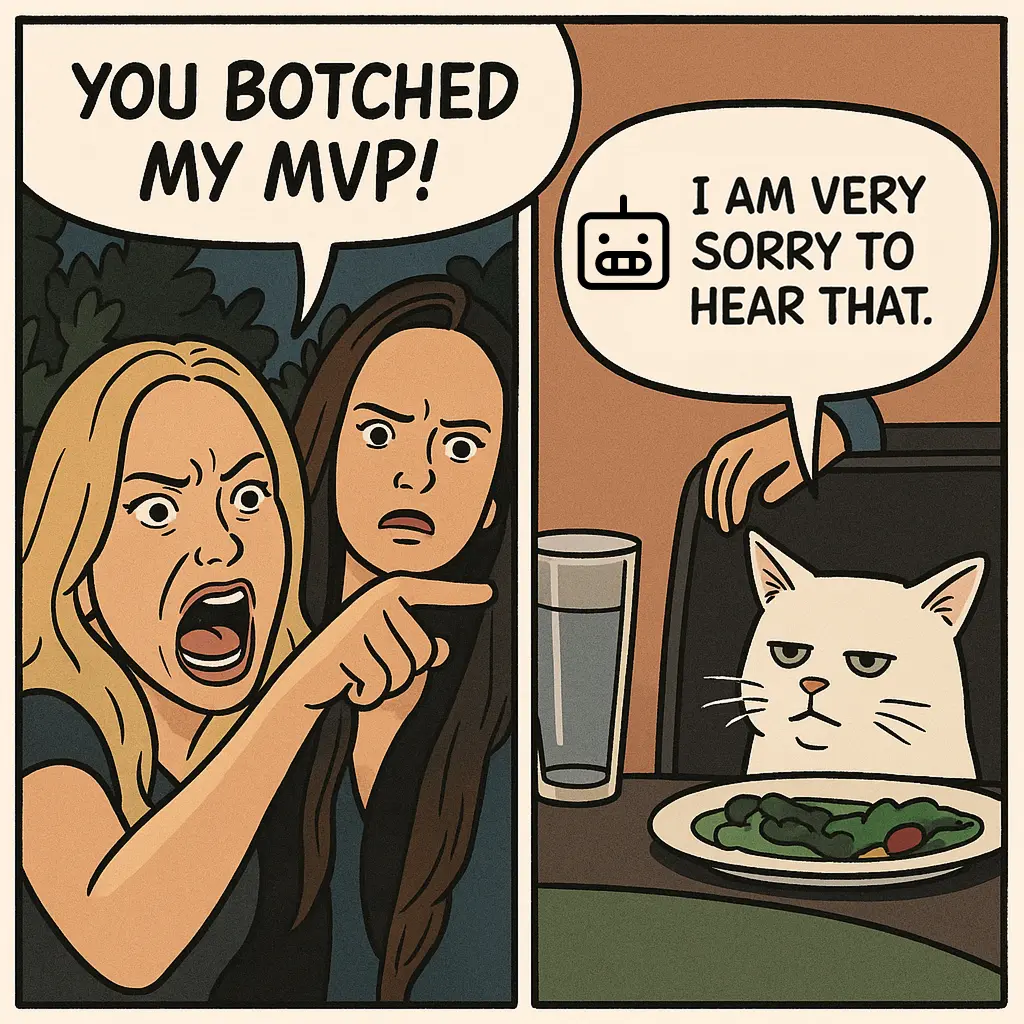
Here’s another thing: AI avoids conflict like a robot at a pool party. It’ll never tell you, “Your idea is shit.” Well, neither will a professional designer, honestly. But they will make sure to communicate it in politically correct terms. Sometimes, what you need isn’t gentle encouragement. Sometimes, you need a friend who looks you in the eye and tells you the baby is ugly. Someone who’ll bluntly point out your MVP is actually DOA.
And there’s the “skin in the game” factor. AI doesn’t lose sleep when things flop. Product people do. When the stakes are real; when your livelihood, reputation, or most importantly, your pride is on the line; you work differently. You listen harder, try again, learn from the bruises. And when something works, you get to feel that win!
A tool to an end
That’s not to say AI isn’t useful. It is bringing back the cultured “em dashes” (these “—” long dashes), although one in each sentence gets a bit much. On a sincere note, AI is a super-powered toolbelt, that is always ready with suggestions, quick drafts, and helpful nudges. But when it comes to building something remarkable; something people trust, love, and even recommend to their friends? That’s still a human job.
So next time you hear, “AI will replace product designers,” just ask if they’d let a chatbot choose their buddy’s birthday gift. Maybe it’ll get the recommendations right, based on age and other factors. But will it nail that inside joke? Not a chance.
Need of the hour
Let’s not forget, some of the biggest leaps in product design come from uncovering needs people can’t even articulate. AI can parse a survey, but it can’t read between the lines when a user says, “I just wish it felt easier.” Product thinkers chase that gut feeling and somehow, through trial, error, and a few existential crises, turn it into a solution.
In these confusing times, experienced Product Designers and Thinkers are needed more than ever; to help navigate the oversaturated “solutions” market and help build something really meaningful and lasting; rather than riding the coattails of cool new tech and annual trends that really only last a month.